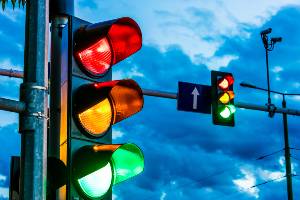
Right-of-way rules tell drivers who is supposed to go first in a given situation, but they don’t work the way people sometimes assume after a crash. Having the right of way is not a license to proceed without regard for safety. A driver who technically had the right of way may still bear some fault for a crash depending on the circumstances. Here’s how Louisiana’s right-of-way rules actually work, intersection by intersection, and how they connect to fault after a crash.
This distinction between “who had the right of way” and “who’s at fault” can cause confusion after a crash. It’s tempting to think that if you had the right of way, you couldn’t possibly be at fault, and if the other driver violated it, they must be entirely responsible. Louisiana law doesn’t work quite that cleanly, and the sections below walk through both the specific rules and how they actually get applied when a crash happens.
What “right of way” means and why it is not a license to proceed unsafely
Right-of-way rules establish which driver is legally entitled to proceed first in a given traffic situation. They exist to create predictability at intersections and other conflict points, not to give any driver blanket permission to ignore what’s actually happening around them. Even a driver with the right of way is expected to exercise reasonable care, and a driver with the right of way may still be assigned some fault depending on the circumstances. Right of way is a starting point for analyzing a crash, not the end of the analysis.
A helpful way to think about it: right-of-way rules answer the question “who was supposed to go first,” while fault analysis answers the broader question “did each driver’s conduct contribute to the crash under the circumstances.” Those two questions usually point in the same direction, but not always. A driver with the right of way may still share fault if that driver’s own conduct contributed to the crash even though the other driver technically violated their right of way.
"I have used Galloway Jefcoat a few times and have always been very satisfied. Furthermore, all of the people who work there are very professional, nice, and courteous."

Four-way stops and vehicles arriving at the same time
At an intersection controlled by stop signs in all directions, Louisiana law is straightforward on the core rule: the first vehicle to come to a complete stop has the right to proceed first. If two or more vehicles arrive at the same time, the vehicle on the left must yield to the vehicle on the right. Disputes may arise over who stopped first or whether the vehicles arrived at the same time, which is why witness accounts and any available video evidence may be important.
One situation that can arise at a four-way stop involves two drivers, each believing they had already established the right to go, proceeding at the same time. When this happens, the actual sequence of events, not each driver’s honest belief about what happened, determines fault. A driver’s belief about who stopped first may differ from what the available evidence ultimately shows, which is one reason prompt evidence-gathering may be important.
Two-way stops and through traffic
At a two-way stop, only cross traffic faces a stop sign; traffic on the through road has the right of way and isn’t required to stop. A driver facing the stop sign must come to a complete stop and yield to all traffic already in the intersection or approaching closely enough to constitute an immediate hazard, only proceeding once it’s clear to do so safely. This type of crash may involve a driver who stops and then pulls into the path of through traffic after misjudging its speed or distance.
It’s worth noting that a through-traffic driver isn’t automatically free of fault just because they had the right of way. A through driver traveling significantly over the speed limit, or one who had a clear opportunity to avoid a collision with a vehicle that had already entered the intersection and failed to brake or swerve when reasonably able to, may still be considered in the fault analysis, even though the other driver was the one who violated the stop sign.
"As a client of Galloway Jefcoat for over two years I want to take a minute to say how much I appreciate the team handling my case."
Uncontrolled intersections
At an intersection with no stop signs, yield signs, or traffic signals in any direction, Louisiana law generally applies a simple rule: when two vehicles approach or enter at approximately the same time, the vehicle on the left must yield to the vehicle on the right. When a traffic-control signal is completely dark, Louisiana law treats the intersection as an all-way stop, with traffic proceeding according to the right-of-way rule in La. R.S. 32:121(A). Uncontrolled intersections can create ambiguity about who actually arrived first, which can make fault more difficult to determine.
These crashes can be more difficult to evaluate than crashes involving a clearly controlling stop sign, precisely because there’s no sign or signal creating an obvious record of who was supposed to yield. Both drivers may have entered the intersection believing, in good faith, that they had the right of way. Without independent evidence like a nearby camera or a disinterested witness, these cases can come down to physical evidence: point of impact, damage patterns, and vehicle positioning after the crash, all of which can help reconstruct who actually entered first.
"Great experience, from day 1 I felt like I finally had someone on my side and that feeling didn't leave me for 1 single moment."
Left turns, U-turns, and oncoming traffic
A driver turning left at an intersection must yield to oncoming traffic that is already in the intersection or close enough to present an immediate hazard, regardless of whether the turning driver has a green light. This applies whether the intersection is controlled by a signal, a stop sign, or nothing at all: the basic obligation is the same. Misjudging the speed or distance of oncoming traffic can contribute to left-turn crashes, and failure to yield may be relevant to determining fault, absent some unusual circumstance like the oncoming driver running a red light or traveling at a clearly excessive, unanticipated speed.
The right-of-way rule in a left-turn crash may provide an important starting point for evaluating fault, precisely because the underlying rule is so clear: yield to oncoming traffic that’s already there or close enough to be a hazard. That clarity doesn’t mean these cases are always simple, though. Disputes often focus on exactly how much time or distance the oncoming driver actually had, and whether the oncoming vehicle was traveling at a speed the turning driver could reasonably have anticipated. The speed and conduct of the oncoming driver may also be relevant to the fault analysis.
Right turn on red in Louisiana
Louisiana allows a driver facing a steady red signal to turn right after coming to a complete stop, unless a sign specifically prohibits it, but only after yielding to pedestrians in the crosswalk and to other traffic lawfully using the intersection. A similar rule allows a left turn on red specifically when turning from a one-way street onto another one-way street, again only after stopping and yielding, and only where signage doesn’t prohibit it. The obligation to yield here is not optional or a formality: a driver who turns on red without actually yielding to traffic or pedestrians with the right of way can be found at fault for a resulting crash.
Pedestrians, crosswalks, white canes, and guide dogs
When traffic-control signals are not in place or not operating, drivers must stop and yield to pedestrians crossing within a crosswalk as provided by Louisiana law. Louisiana law also requires drivers approaching certain pedestrians using a guide dog or qualifying cane to take necessary precautions to avoid injury or danger and, when necessary, come to a complete stop. That said, pedestrians also have obligations of their own, including not suddenly entering a roadway from a place of safety when a vehicle is too close to safely yield. As with vehicle-to-vehicle right of way, this is a shared-responsibility framework, not a one-sided rule.
Crosswalk crashes often turn on visibility and timing: was the pedestrian clearly within the crosswalk when the driver should have seen them, and did the driver have a reasonable opportunity to stop. A driver’s attention and conduct when approaching or turning through a crosswalk may be relevant to determining fault. Louisiana law also provides that a pedestrian may not suddenly leave a curb or other place of safety and enter the path of a vehicle that is so close the driver cannot yield.
Merging and lane-change duties
A driver merging into traffic or changing lanes generally bears the duty to do so safely and to yield to traffic already established in the lane being entered. The specific duty depends on whether a driver is changing lanes, entering a roadway, or merging into traffic. A driver already traveling in a lane generally has the right of way over a vehicle attempting to merge into it, though, as with every right-of-way rule discussed here, that right of way doesn’t excuse a driver who had a clear, safe opportunity to avoid a crash and failed to take it.
Lane-change and merging crashes may involve conflicting accounts about signaling, blind spots, and following distance, since there’s rarely a stop sign or signal to anchor the analysis. Dashcam footage, when available, may help clarify what each vehicle was doing in the seconds before impact, which may otherwise be difficult to reconstruct from physical evidence alone.
How a traffic violation affects — but does not automatically decide — civil fault
A citation or traffic violation connected to a crash is meaningful evidence, but it doesn’t automatically decide fault in a civil injury claim. Louisiana applies a modified comparative fault framework under Civil Code article 2323, under which fault may be apportioned among the persons who caused or contributed to the injury. More than one person may be assigned a percentage of fault based on the circumstances of the crash. Because Louisiana’s current modified comparative fault rule generally bars recovery when the injured person’s own negligence is 51% or greater, understanding how fault may be apportioned is an important part of evaluating an intersection crash claim.
Evidence used to determine fault after an intersection crash
Because right-of-way disputes may involve contested factual questions (who arrived first, who had a stop sign, who had a clear opportunity to avoid the crash), the available evidence can be important in determining fault. This typically includes the police crash report, photos of vehicle positions and damage, witness statements, any available traffic camera or dashcam footage, and the physical evidence at the scene, such as skid marks or debris patterns. Gathering and preserving available evidence promptly may help provide a clearer record of what occurred, since memories fade and physical evidence at a scene doesn’t last.
Questions about right-of-way as they pertain to your traffic accident? Contact the Lafayette car accident lawyers at Galloway Jefcoat today to discuss your circumstances.
"Galloway Jefcoat helped me at a time when I felt lost and taken advantage of by my employer."